AI finds the possibilities
AI suggests recovery possibilities for each slowing product and helps explain what changed. A possibility on its own has not been validated and cannot be launched.
Velocity Pulse for Shopify · by Sparande
Velocity Pulse detects products losing sales momentum early, explains what changed and helps merchants act before slow-moving inventory becomes dead stock.
Dead stock rarely announces itself. A product's sales soften for weeks while it keeps sitting on the shelf, and by the time it shows up in a report the only option left is often a deep clearance. Velocity Pulse flags the slowdown while the stock still sells, so a lighter, cheaper response still works.
A little over a minute, with real screens from the app. AI only suggests ways to recover a slowing product. Whether an idea is safe to launch is always decided by deterministic, quantitative mathematics, tested for demand, price response, expected value and confidence against your margin floor and discount limits. AI never sets a discount, and AI-found possibilities never launch on their own.
AI finds the possibilities. Our maths verifies what is safe to launch. A slowing product has many possible fixes, and most of them cost margin. So we split the work. AI does what it is good at, spotting recovery possibilities across a whole catalogue. Mathematics does what it is good at, proving whether acting would earn more than doing nothing. AI never sets a discount, and nothing reaches your store on the model's word alone.
AI suggests recovery possibilities for each slowing product and helps explain what changed. A possibility on its own has not been validated and cannot be launched.
Deterministic, quantitative models test each idea for demand, price response, expected value and confidence, against your margin floor and discount limits. Ideas that fail are never launched, and you are told why in plain words.
Only validated recommendations reach you for approval. An approved action launches through Shopify, rolls back if you cancel, and is measured against how the product was selling before it.
Every idea is labelled with where it stands, from AI-discovered possibility to measured outcome, and none of those labels credits the model with the recommendation. A validated recommendation carries an expected value, a confidence level and a discount depth that respects your margin floor. Then the maths gives its verdict.
| Verdict | What the maths found | What happens next |
|---|---|---|
| Quantitatively validated | The idea passed its tests against your evidence and economics, at a discount depth that respects your margin floor. | It reaches you for approval with its expected value and confidence level. You still decide whether to launch it. |
| Tested and not launched | The idea failed. For example, the slowdown is not yet statistically credible, no discount depth keeps you above your margin floor, or it would not earn more than doing nothing. | Nothing changes in your store, and you are told why in plain words. |
| Referred for specialist evaluation | The better answer is a bundle, which needs its own economics. | The opportunity is referred to Bundle Optimizer, which evaluates it, and you see the referral's status. |
Nothing is recommended below your margin floor; if a unit cost is missing, the idea is held and you are told why. AI never sets a discount: quantitative mathematics decides, every time.
Every recommendation comes with the numbers behind it, and a prepared campaign waits for you before anything reaches your storefront.
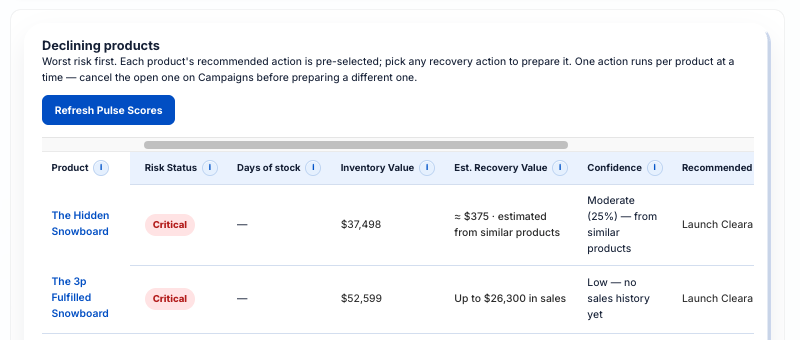
Slowing products are ranked worst risk first, with the capital tied up in their stock. Beside each product sit the estimated recovery value, the confidence behind that estimate and the recommended action, already selected for you.
The confidence column is honest about its evidence. Here one estimate is marked moderate because it comes from similar products, and another is marked low because the product has no sales history yet.
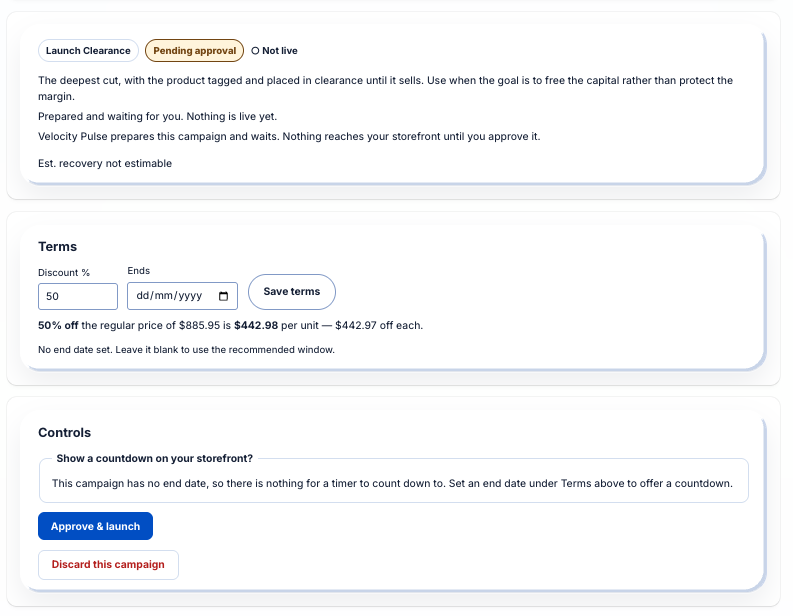
Pick a recovery action and Velocity Pulse prepares the campaign, then waits. The status reads pending approval and not live, and nothing reaches your storefront until you approve it.
The terms are yours to set, and the result is worked out before you commit. Here 50% off the regular price of $885.95 is $442.98 per unit. Where a recovery figure cannot be estimated, the app says so rather than guessing.
Approve and launch when you are ready, or discard the campaign.
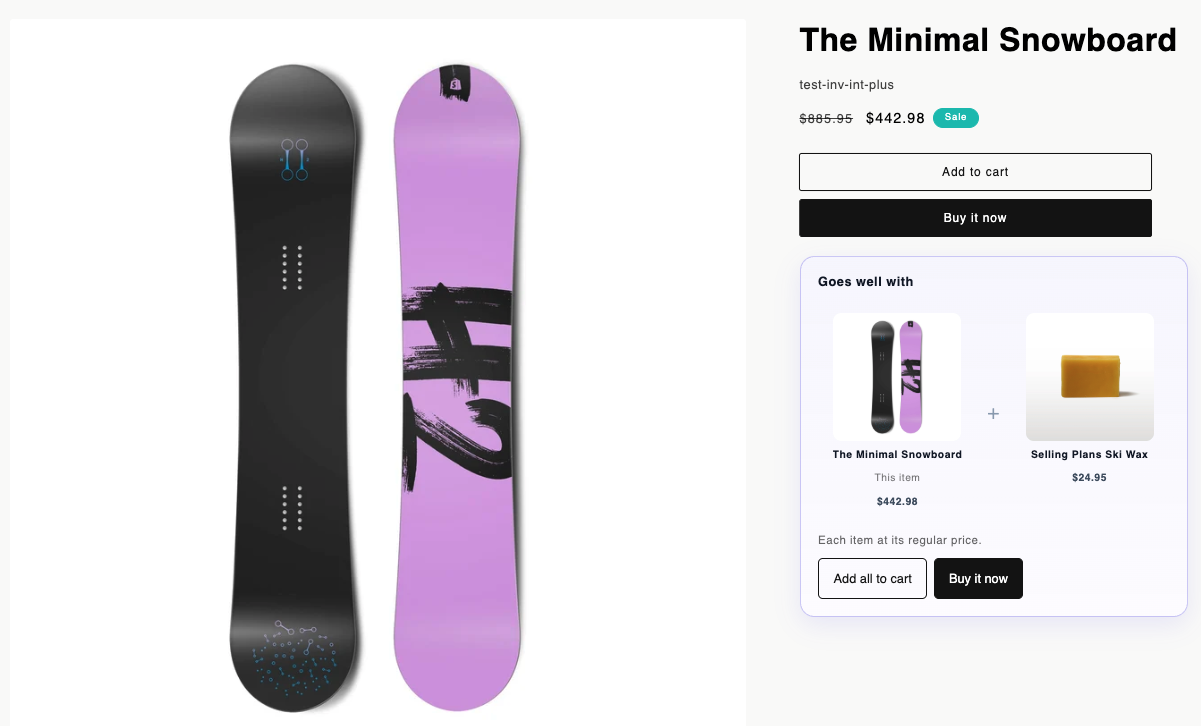
This is the same campaign after approval. The product page shows the regular price of $885.95 struck through, the sale price of $442.98 and a sale badge, exactly as the terms said it would.
Cancel the campaign and the previous price is restored. Storefront badges and countdowns for live recovery campaigns are optional, and need an Online Store 2.0 theme.
Each product's recent daily sales are tested against its own baseline, not a store-wide threshold. Products are scored after every catalogue sync and again every night.
Each slowdown comes with a plain-English explanation of what changed and the possible causes worth checking.
Markdowns, flash sales and clearance, launched through Shopify and rolled back if you cancel. When the better answer is a bundle, Velocity Pulse refers the opportunity to Bundle Optimizer, which evaluates it.
AI suggests recovery possibilities, and our quantitative models test every one before it can reach you. Each launch is measured against how the product was selling before it.
Illustrative example
The baseline is the product's own healthy selling period. Velocity Pulse flags the decline once it is statistically real, while the stock is still sellable. The shaded area is the difference acting early can make; the figures are illustrative, not a promise.
A Pulse Score from 0 to 100 on every monitored product, with a risk band. Slowing products are ranked worst risk first, with the capital tied up in their stock.
Each slowdown comes with a plain-English explanation of what changed and the possible causes worth checking.
A validated recommendation carries an expected value, a confidence level and a discount depth that respects your margin floor. Ideas that fail are never launched, and you are told why in plain words.
You approve each action. Autonomous mode is opt-in, and AI-found possibilities never launch on their own. Each launch is measured against how the product was selling before it.
Every plan includes every feature. Plans start at $9.99 a month for up to 200 products, with a 14-day free trial billed through Shopify. Compare the Velocity Pulse plans.
Velocity Pulse detects products losing sales momentum early, explains what changed and helps merchants act before slow-moving inventory becomes dead stock. It is an app for Shopify stores, made by Sparande, and it runs inside Shopify admin.
Shopify merchants whose catalogue is too large to watch every product by eye, and who want to act on a slowing product while its stock still sells, rather than clear it once it has stopped.
It compares each product's recent daily sales with that product's own baseline, using a statistical test, and turns the result into a Pulse Score from 0 to 100 with a risk band. Products are scored after every catalogue sync and again every night. The quantitative analysis determines the signal; nothing is flagged on a hunch.
Slowing but still selling: Velocity Pulse, early and light-touch. What belongs elsewhere:
AI finds the possibilities. Our maths verifies what is safe to launch. Every plan starts with a 14-day free trial.
Privacy and security · Help and documentation · Privacy Policy · Terms of Service