AI finds the possibilities
AI proposes a price for each product, with the evidence behind it. It works alongside our fixed pricing rules, so it catches what the rules alone would miss.
Sparande E-commerce · A focused app powered by SparGrid
Every product has a price that earns the most, and almost none of them are on it. Margin Optimizer uses AI to read your catalogue, costs, sales and your own pricing notes, and to propose prices your fixed rules would never have flagged.
AI finds the possibilities. Our maths verifies what is safe to launch. Every proposal is checked against your costs, your minimum margin and your price limits before it can be launched. AI never sets a price: every price is decided by deterministic, quantitative mathematics, and the same inputs give the same answer every time. You decide what goes live, and every change is reversible.

A little over a minute, with real screens from the app. AI only suggests where your catalogue may be losing margin. Whether a price is safe is always decided by deterministic, quantitative mathematics, tested against your unit costs, break-even, minimum margin and price limits, so the same inputs always give the same answer. AI never sets a price, and nothing launches until you approve it.
Repricing is where AI can earn you the most and cost you the most. So we split the work. AI does what it is good at, spotting opportunities across a whole catalogue. Mathematics does what it is good at, proving whether a price is safe. AI never sets a price, and nothing reaches your store on the model's word alone.
AI proposes a price for each product, with the evidence behind it. It works alongside our fixed pricing rules, so it catches what the rules alone would miss.
A separate check in deterministic, quantitative mathematics tests the proposed price against your costs and limits. Any uplift or confidence the model claims is set aside; only the maths counts.
A price that passes is launchable at the checked price, now, on a schedule, or as a test. Nothing reprices automatically, and every change can be rolled back.
An opportunity is labelled by where it came from: found by AI, found by our fixed rules, or found by both. Each AI proposal shows the price it suggests, what it noticed in your data, what evidence would make it measurable, and how many of your own notes it used. Then the maths gives its verdict.
| Verdict | What the maths found | What happens next |
|---|---|---|
| Safe to launch | The price clears break-even, your minimum margin and your price limits. | Launchable at the checked price, never at a figure the model made up. You still decide whether to launch it. |
| Fixable | The price breaks a limit, but a workable price exists inside your rules. | You see break-even, the price that meets your target and the range that fits every limit. AI gets one more try inside that range, checked again from scratch. |
| Not launchable | No workable price exists, a cost is missing, or the demand evidence says the price would earn less. | Nothing changes in your store, and you are told exactly why. |
Your guardrails are never widened to make a proposal fit. If the check cannot verify a price, the proposal stays visible so you can learn from it, and it stays unlaunchable. AI never sets a price: quantitative mathematics decides, every time.
Every decision comes with the numbers behind it, so a price change is a choice you make with your eyes open rather than a setting you hope is right.
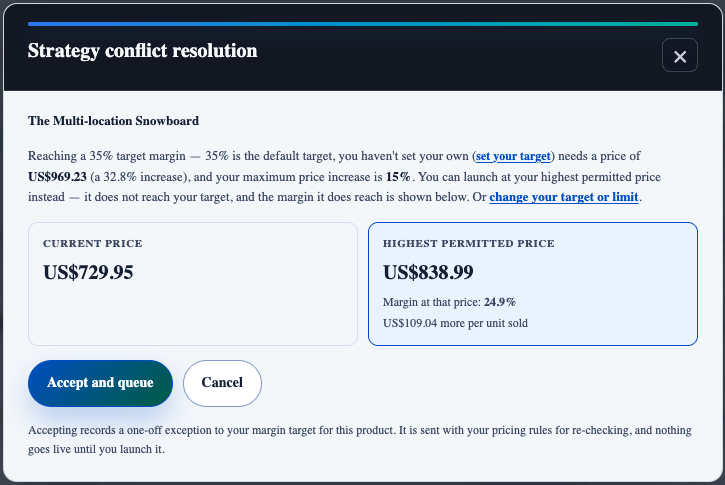
Sometimes reaching your target margin needs a bigger price rise than your limit allows. Margin Optimizer does not quietly pick one for you. It shows the price your target needs, the highest price your limit permits, and exactly what margin that price would earn.
You can accept the highest permitted price as a one-off exception for that product, or change your target or limit. An accepted exception is sent back with your pricing rules to be checked again, and nothing goes live until you launch it.
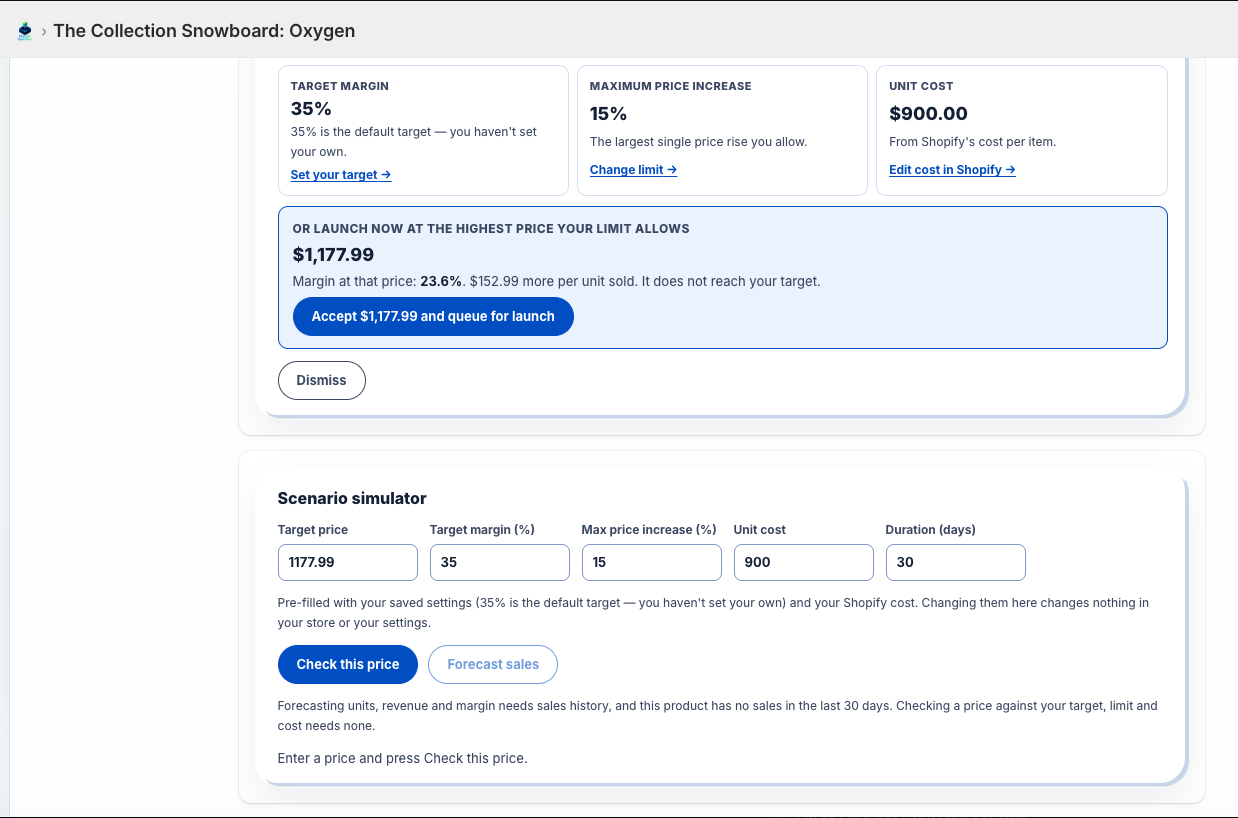
Try any target price against your target margin, maximum price increase, unit cost and a time window. The simulator is pre-filled from your saved settings and your Shopify cost, and changing a value here changes nothing in your store or your settings.
Checking a price against your target, limit and cost works from day one. Forecasting units, revenue and margin waits until the product has sales history, and the simulator says so plainly rather than guessing.
Most prices are fixed at launch by a simple cost-based rule and never revisited, while costs, competition and demand keep moving underneath them. That leaves every product sitting somewhere on a curve it was never placed on deliberately, and both directions off the peak cost you money.
A price fixed at launch is a decision that keeps being made every day afterwards, by default, with nobody looking at it.
Underpricing gives away margin you would have been paid anyway. Overpricing costs more volume than the extra points are worth.
A blanket increase is not a pricing strategy. The right move differs for every product, and moves again as your costs and demand do.
Syncing and analysis need no buttons. They run on install, then nightly. You step in at one place: choosing which opportunities to launch. Between your choice and your storefront sits a gate you configure, and nothing is written to Shopify that has not passed it.
Every opportunity is anchored to a figure you can see and correct: gross margin per product, which is price less your own unit cost. When a product's cost is assumed or incomplete, it is labelled that way, and it cannot be launched until the cost is known. A missing figure is never shown as zero.
Repricing is the part of merchandising nobody wants automated on trust alone. So the controls are not settings buried behind the recommendations. They are the thing the recommendations have to pass through.
Set the lowest price you will accept, a minimum value below which an opportunity is not worth your attention, and exclusions by product, collection or supplier. Excluded products are never repriced, and never even surfaced.
Decide how much confidence a recommendation needs, and how large a price move may be, before you are shown it. Applies across your whole product range.
Check activation and launch separately, with named reviewers and a fallback role. If nobody is available, requests are held rather than waved through.
Every change records the price it replaced. A repeated launch cannot apply the same change twice, and restoring the previous price is a single action.
Every figure states which costs it includes. Estimates are labelled clearly and are never quietly mixed with measured results.
AI proposes and explains in plain language, but AI never sets a price. Every amount and percentage on screen is calculated by quantitative mathematics from your data, and the prose never changes a figure.
| Stage | What you set | What happens when it is not met |
|---|---|---|
| Discovery | Excluded products, collections or suppliers, and a minimum opportunity value. | Excluded products are never analysed or shown as recommendations. |
| Recommendation | Minimum price and caution level. | Prices below your minimum are never proposed. |
| Activation | Named reviewer, with a fallback role. | The request is held. An unassigned review never approves itself. |
| Launch | A second approval, immediate, scheduled or run as a test. | Nothing is written to Shopify. The current price stays live. |
| After launch | Nothing. The previous price is saved automatically. | Restore the previous price in a single action, at any time. |
Changing a price is really two questions, and only one of them needs sales history. Margin Optimizer keeps them apart, so a new product still gets the answer that its costs can provide.
Mode 01 · day one
Weighs each price against what the product costs you and the minimums you have set, and flags the ones that are wrong on cost alone, including any drifting toward your minimum as costs move.
No sales history required. It works from your first data connection.
Mode 02 · once proven
Uses real sales history for that specific product to find the price that earns most, which is rarely the highest price your rules would permit.
Waits for enough sales history. Until a product has it, the recommendation says so plainly instead of guessing.
| Margin protection | Sales-led pricing | |
|---|---|---|
| The question | Is this price wrong on cost alone? | Which price earns the most on this product? |
| Data needed | Cost per item and your minimum prices. | Enough orders to measure demand for that product. |
| Available from | Your first sync, day one. | Once enough sales history exists for that product. |
| Typical finding | A product sitting under its minimum after a supplier cost rise. | A product that earns more at a price below the one your rules allow. |
| When evidence is thin | Still answers. Costs do not need sales history. | Says so plainly rather than guessing. |
Estimates are easy to publish and difficult to check. So the dashboard keeps the two apart: what a change was expected to earn, and what the orders linked to it actually did earn. When a figure is estimated, it is labelled clearly, and it is never quietly added to the measured one.
Margin Optimizer is a focused app that runs on the SparGrid platform. It puts the Margin Protection agent to work on one job: finding the margin you are losing and launching only the price changes the maths has verified as safe. SparGrid itself runs ten business agents and sixty capabilities across every channel, so when you need more than margin, you can adopt the full platform without changing tools.
Margin Optimizer finds the margin you are losing. AI suggests where to look; deterministic, quantitative mathematics decides every price, because AI never sets a price. Your team stays in control of every change. Every plan includes every feature and a seven-day free trial.
Diagrams on this page are illustrative and are not a forecast of results. Every figure in the app states which costs it includes. Margin Optimizer works through Shopify, changes prices only with confirmation, and every change can be reverted.
Legal: Privacy Policy · Terms of Service